Letters
Letters are the oldest form of business messages. The ancient Chinese wrote letters as did the early Egyptians, Romans, and Greeks. From these early days, letters have continued to be used in business. Although there are various communication tools, they are still the best choice for many communication tasks.The general purpose of a letter is to represent the writer and his/her topic rather formally to the recipient. For this reason, letters are used primarily for corresponding with people outside the organization. When you write to internal readers, they are often familiar to you- and even if they are not, you all share the connection of being in the same company. Your messages to such audiences tend to use less formal media. But when you write to customers, to suppliers, to citizens and community leaders, and to other external audiences, you will often want to present a professional, polished image of your company by choosing the letter format, complete with an attractive company letterhead and the elements of courtesy built into this traditional format.
Characteristics of a Good Letter
There are three main characteristics that can be identified in a good business letter:
Clear content- Separating ideas into paragraphs, uses short sentences and paragraphs and guiding the reader through the ideas with transitional expressions. Moreover, a clear letter uses familiar words and active-voice verbs.
A tone of goodwill- Creating a positive feeling in the readers mind through the letter toward the organization.
Correct form- Selecting the most appropriate format which helps in its best possible way to impress the reader.
Structure of the FORMAL & INFORMAL letters
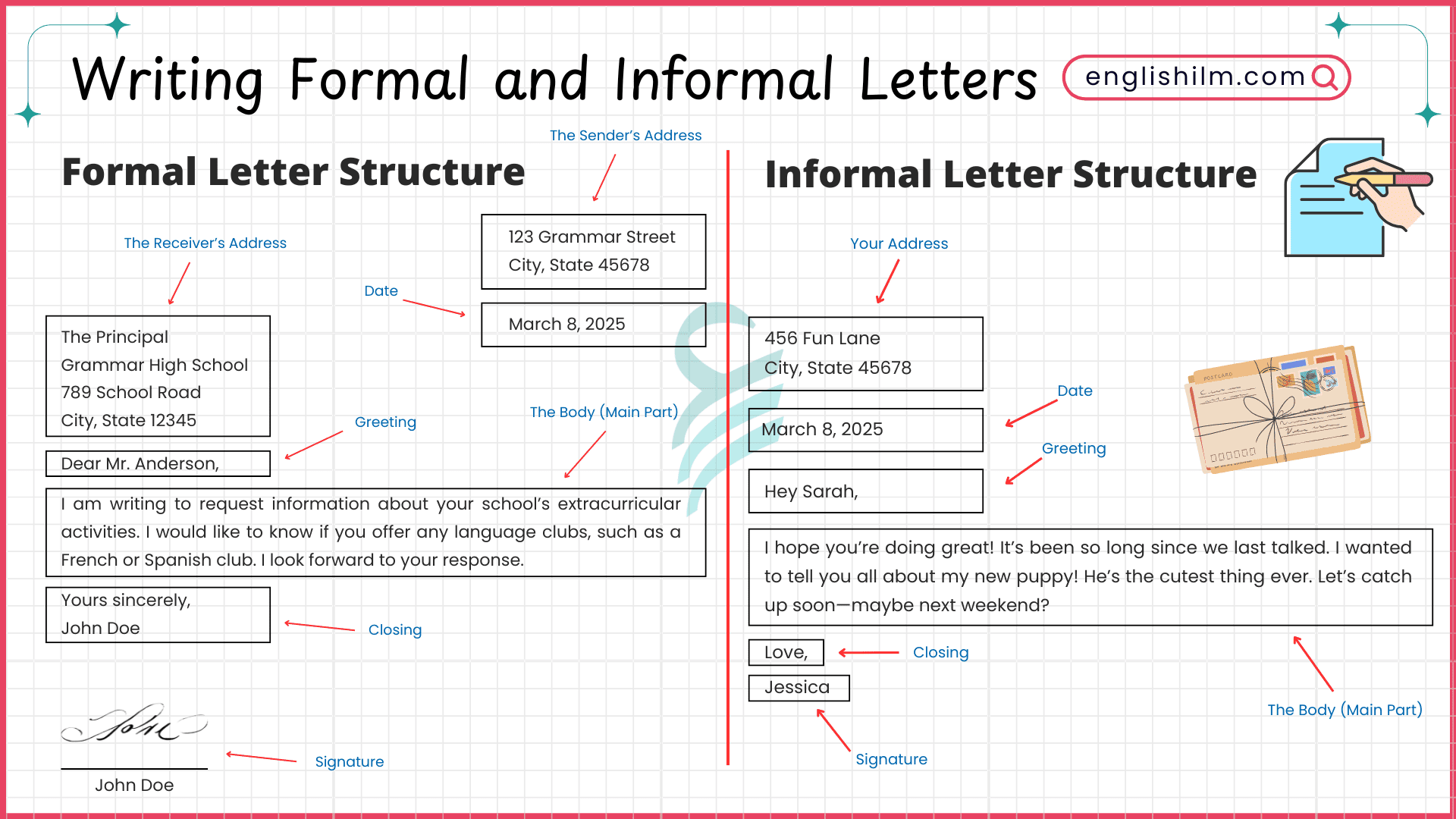
Types of Business Letters
Inquiry Letters
-
Ask for information about products, services, prices, or policies
-
Example: Requesting details about a course or product
Order Letters
-
Place an order for goods or services
-
Include quantities, specifications, and delivery details
Complaint Letters
-
Express dissatisfaction with a product or service
-
Explain the problem and request a solution
Recommendation Letters
-
Provide references for employees or students
-
Highlight skills and character
Acknowledgment Letters
-
Confirm receipt of orders, payments, or documents
Resignation Letters
-
Formally inform an employer of leaving a job
Self Assessment
Suppose you are the Sales Manager of ABC Company. The company is planning to buy stationary items from XYZ Company. Write the Formal Letter asking about the items and their prices.


“This is an excellent and informative blog that clearly explains the role of letters in business communication. The content is well structured, easy to understand, and highlights both the traditional value and practical use of business letters. It is very helpful for readers who want to improve their professional writing skills.”
ReplyDelete