Organizational Communication
Organizational Communication refers to the flow of information within an organization among employees , managers and departments. It helps to run the organization smoothly and achieve the organizational goals. Organizational Communication can be categorized as follows.
Formal Communication
Formal communication means communication happen throughout the formal structure, information flows in three direction.
Downward Communication
Information flows from top level to bottom level. This is important for communicate goals and strategies, job instructions and rationale, procedures and practices, performance feedback and indoctrination.
Upward Communication
In upward communication, it can be occurred from bottom level to top level. Problems and exceptions, suggestions for improvement, performance reports, grievance and disputes, financial and accounting information can be shared through upward communication.
Horizontal Communication
Information flows in the same level or between colleagues and departments. Horizontal Communication is essential for interdepartmental problem solving, interdepartmental coordination and change initiatives and improvements.
Formal communication channels can be depicted as follows.

Informal Communication
Every organization also has an informal communication network, which is called as the grapevine. This communication takes place naturally as a result of employee interaction both on the job and social meetings. Further, this types of communication sometimes carries gossip and rumor. But informal communication is very important during the time of induction, training and development and performance evaluation. There are four types of information communication types as given in the following picture.
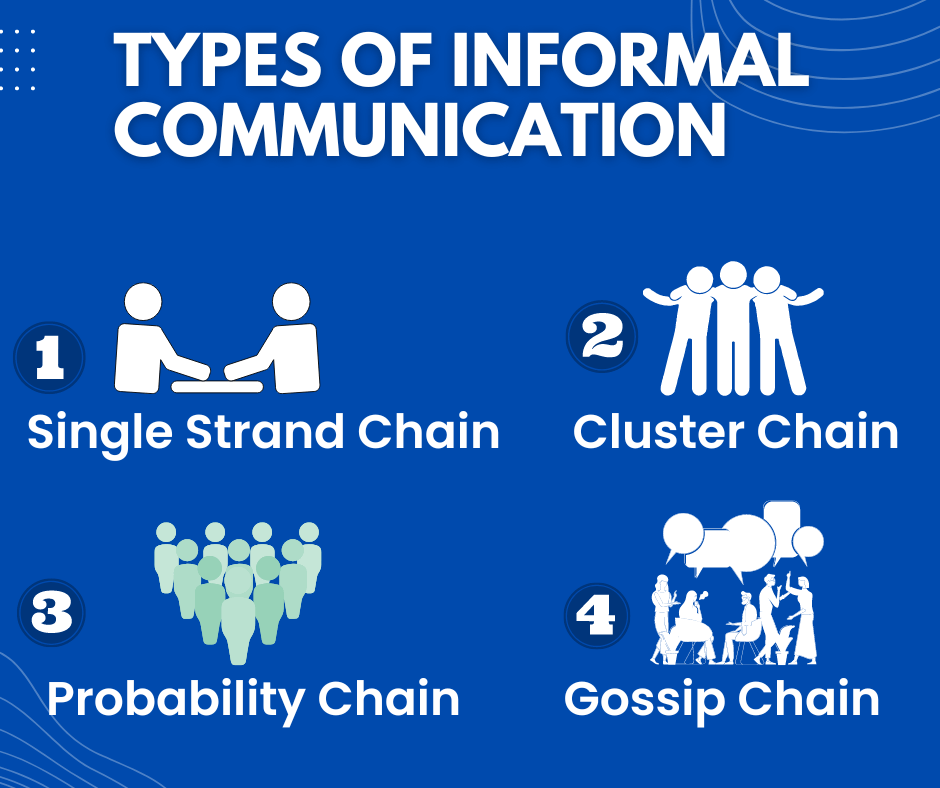
In summary, there are mainly two types of organizational communication namely formal and informal. Formal communication can be categorized as upward, downward and horizontal. Both formal and informal communication are important for an organization.
Try for the Self Assessment.
Explain four types of informal communication networks.
|
|
|||


Well said, Thank you for sharing this informative article. It gives a clear and simple explanation of formal and informal communication and highlights their importance in different settings. The differences between formal and informal communication are well presented. adding some real world examples could make it even more engaging and relatable. Looking forward to read more such insightful articles. Overall this was a very useful and informative read.
ReplyDelete